

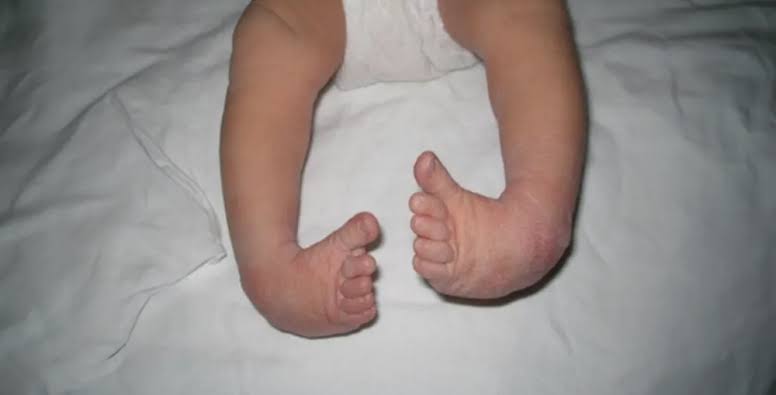

Orthopaedic surgeons have urged parents to seek immediate medical attention for babies born with clubfoot, saying early treatment can successfully correct the condition and significantly reduce the likelihood of surgery.
The specialists also urged Nigerians to abandon myths linking clubfoot to witchcraft, spiritual attacks or divine punishment, stressing that the congenital deformity has a medical basis and is treatable.
They warned that delayed treatment could leave children with permanent disability, chronic pain, difficulty walking and social stigma, potentially affecting their education, employment and overall quality of life.
Clubfoot, medically known as talipes equinovarus, is a congenital condition in which one or both feet are twisted inward and downward. The Cleveland Clinic estimates that about one in every 1,000 babies is born with the condition, making it one of the more common congenital deformities affecting the feet.
The condition occurs when the tendons in a baby’s leg and foot are shorter and tighter than normal, causing the foot to twist. About half of affected babies have clubfoot in both feet.
In Nigeria, more than 10,000 children are estimated to be born with clubfoot every year, according to Nigeria Clubfoot Treatment Partners.
Although the exact cause of idiopathic clubfoot remains unknown, experts say genetics and environmental factors may play a role. A family history of the condition has been associated with increased risk, while certain pregnancy-related factors have also been investigated.
Speaking on the condition, Professor of Orthopaedic and Trauma Surgery, Mike Ogirima, said most cases of congenital or idiopathic clubfoot could be corrected without surgery when treatment begins early.
Ogirima, a former President of the Nigerian Medical Association and Provost of the College of Health Sciences, Federal University Lokoja, explained that idiopathic clubfoot accounts for the majority of cases seen by orthopaedic specialists.
He said another form, known as acquired or secondary clubfoot, could develop after birth as a result of conditions such as infection, trauma or poliomyelitis.
According to him, modern treatment has moved away from extensive surgical procedures, with physical manipulation now forming the basis of treatment for most idiopathic cases.
He said the Ponseti method, which involves a series of gentle manipulations and casting, can achieve a very high rate of correction when properly administered.
“Treatment is easier from day one of life,” Ogirima said, explaining that the Ponseti protocol involves serial manipulation of the different components of the deformity.
He added that after several weeks of treatment, even severe cases could be substantially corrected.
The surgeon expressed concern that cultural beliefs and stigma continue to prevent some Nigerian parents from seeking treatment early.
He said some families wrongly interpret the condition as evidence of a curse, punishment from God or witchcraft, while others seek help from traditional bone setters instead of qualified medical professionals.
Ogirima said such misconceptions were dangerous because they often result in delayed presentation.
By the time some patients eventually reach an orthopaedic specialist, he noted, they may already be adults with severely deformed feet. At that stage, treatment can become more complicated, expensive and may require surgery.
He stressed that early presentation makes treatment easier, less expensive and less physically demanding for the child.
Meanwhile, Consultant Orthopaedic Surgeon and President of Nigeria Clubfoot Treatment Partners, Dr Peace Amaraegbulam, described clubfoot as the most common musculoskeletal birth defect.
She said untreated children could eventually be forced to walk on the sides of their feet, resulting in severe pain, difficulty walking and social discrimination.
Amaraegbulam said the Ponseti method remains an effective treatment option but identified several barriers preventing Nigerian children from receiving care.
These include the high cost of treatment for families paying out of pocket, limited access to healthcare facilities, inadequate numbers of trained healthcare professionals and shortages of foot-abduction braces needed after correction.
The experts therefore called for greater public awareness and stronger efforts to identify affected babies immediately after birth.
They also urged parents not to hide children born with clubfoot because of shame or fear of stigmatisation.
With early diagnosis and appropriate treatment, specialists said, most children with idiopathic clubfoot can achieve functional, pain-free feet and lead normal, active lives.